About
We measure first and talk after.
Most sites do not lose visitors to competitors. They lose them to a missing title, a redirect that drops the path, a page that has never been indexed. Each one quietly costs you ranking.
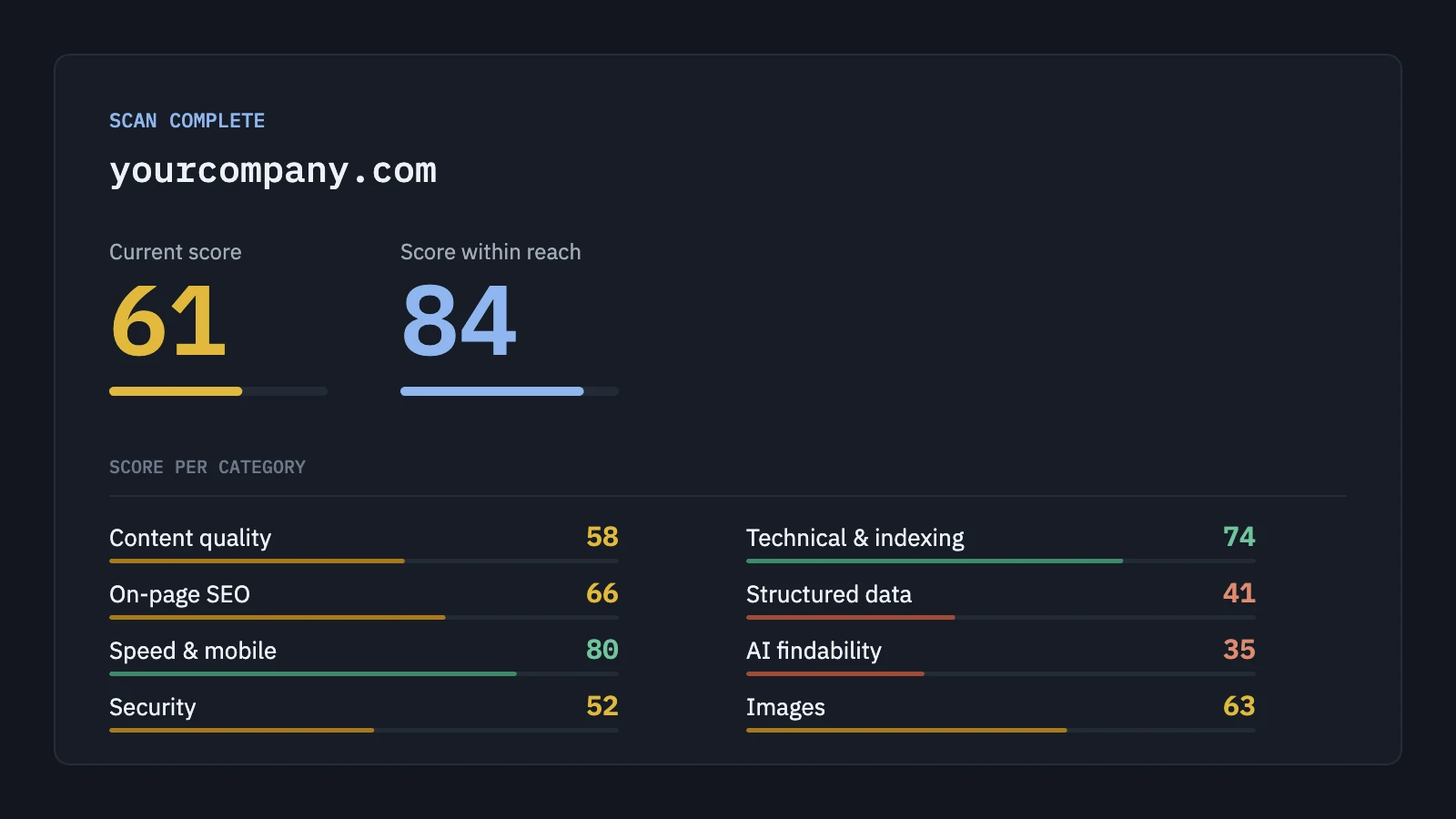
NowConsulting measures your site across eight categories and shows you the two numbers that matter: where you stand today, and where you could stand.
More about how this works
The scan works like a browser, not like a checklist. It requests your page, follows every redirect, and reads what actually came back. Each number in the report comes from that one response. Nothing is estimated and nothing is measured in a laboratory. If your server was slow at that moment, the report says so, and it says how slow. The same scan runs on any public address, so you can point it at a competitor just as easily as at your own site.
You get two numbers because one is not enough. The first is what the page scores today. The second is what it scores once the task list has been worked through. That second number is deliberately not a hundred. A score that is almost always perfect measures nothing, so we assume the work gets done well rather than flawlessly.
The full audit goes further than a single page. It reads up to thirty of them and finds what one page cannot show: titles that repeat, internal links that lead nowhere, two addresses serving the same content. Every finding names the page, the code and the change. Each one is marked as work for a developer, for an editor, or for whoever manages the hosting.
What the scan measures
Eight categories, each weighted by how much it moves the needle: content quality, technical and indexing, on-page SEO, structured data, speed and mobile, AI findability, security and images. The norms come from what search engines document publicly - their own guidance on titles, structured data and page experience - not from a house opinion. Where a finding rests on a published rule, the report says which one.
What it costs
The basic scan is free and asks for nothing. A full audit of up to thirty pages is a fixed amount, well under what agencies charge on average. The pricing page lists the four options side by side with the market figures next to them.
Why the second number is never a hundred
The score within reach assumes the task list gets worked through well, not flawlessly. A binary finding - a missing canonical, an absent header, no sitemap - really does get solved. A ratio or a band, such as alt texts or load time, lands on good rather than perfect. Depth of content, internal link structure and server speed keep asking for work and only shift part of the way. That is why a page that starts at forty does not land at a hundred: the number would stop meaning anything if it always did.
What this scan does not do
It reads the page as it was served at that moment, so it says nothing about your rankings, your backlinks or your competitors. It does not run your JavaScript, which means a page that builds its content in the browser looks emptier here than it does to a visitor - and, notably, emptier to a crawler that skips JavaScript too. It measures one page, and only the page at the address you gave. Those limits are deliberate: a number that covers everything usually measures nothing.
Which standards this follows
Structured data is validated against the vocabulary published at schema.org, robots.txt is read the way RFC 9309 describes it, and the machine-readable summary of this site follows the llms.txt convention. All three are open specifications, so you can check any finding against the source rather than taking our word for it.
Evidence
names the pages and the code at fault
Task list
shows exactly what needs to be done
Two scores
before and after, per category
Request an audit
NowConsulting
SEO audit: find out what’s holding your site back.
Your score today. Your score within reach.
See an example result
Scan complete
yourcompany.com
Current score
0
Score within reach
0
These scores come from the free online scan of a single page. The full report scans each category in more depth, so its results can and probably will differ.
Pricing
What an SEO audit costs on average
The market figures are averages for an SEO audit. They are indicative and not the price list of any specific agency.
Basic scan (scores)
one page, in seconds, without leaving your details
Full audit
up to 30 pages - which page, which code, what to change
Extra pages
for larger sites, per 10 pages above the first 30
Follow-up audit
the same audit again, so you can see what actually moved
All amounts excluding VAT. Market averages are an indication based on publicly available rates, not those of one specific agency.
Scan Pricing
What happens after you request one
You get the report within five working days. It arrives as a document you can hand straight to whoever does the work, because every finding names the page, the code and the change. There is no meeting you have to sit through first, and no retainer attached to it.
What is not included is the work itself. We measure and we write down what needs to change; your own developer or editor carries it out. If you want to see whether it worked, the follow-up audit runs the same measurement again so the two reports can be laid side by side.